How to Make Money With Google AdSense in 2026 Without Losing Revenue to Basic Mistakes

Google AdSense pays site owners for ad clicks and impressions, but turning it on does not create revenue by itself. Money appears when useful content, steady organic traffic, sensible ad placement, and clean behavior all work together. If one layer is weak, RPM drops or the site fails review.
The starting plan is simple: pick a niche, publish 15-20 solid articles, add trust pages, submit the site for review, then test ad placements. Dry, yes. But this is exactly where many beginners lose weeks.
What AdSense Is and How Revenue Is Calculated
AdSense is Google's ad network for site owners, bloggers, and content projects. You place ad code on your pages, Google matches ads to the page and audience, and revenue is counted through impressions or clicks depending on the ad type and advertiser demand.
There is no magic payment for 1000 views. Two sites with the same traffic can earn very different amounts. A finance article with US readers may get a high CPC, while an entertainment blog in a cheaper market may see a much lower RPM. That is normal.
| Metric | What it shows | Why it matters |
|---|---|---|
| CPC | revenue per click | estimates niche value |
| CPM | revenue per 1000 impressions | shows advertiser demand |
| CTR | clicks as a share of impressions | helps test ad positions |
| RPM | revenue per 1000 page views | shows the full monetization picture |
A rough forecast works like this: page views multiplied by CTR and CPC. If a page gets 10,000 views per day, CTR stays at 1.5%, and the average click brings 0.40 dollars, daily revenue is around 60 dollars. A forecast, not a promise.
What Affects AdSense Earnings Most
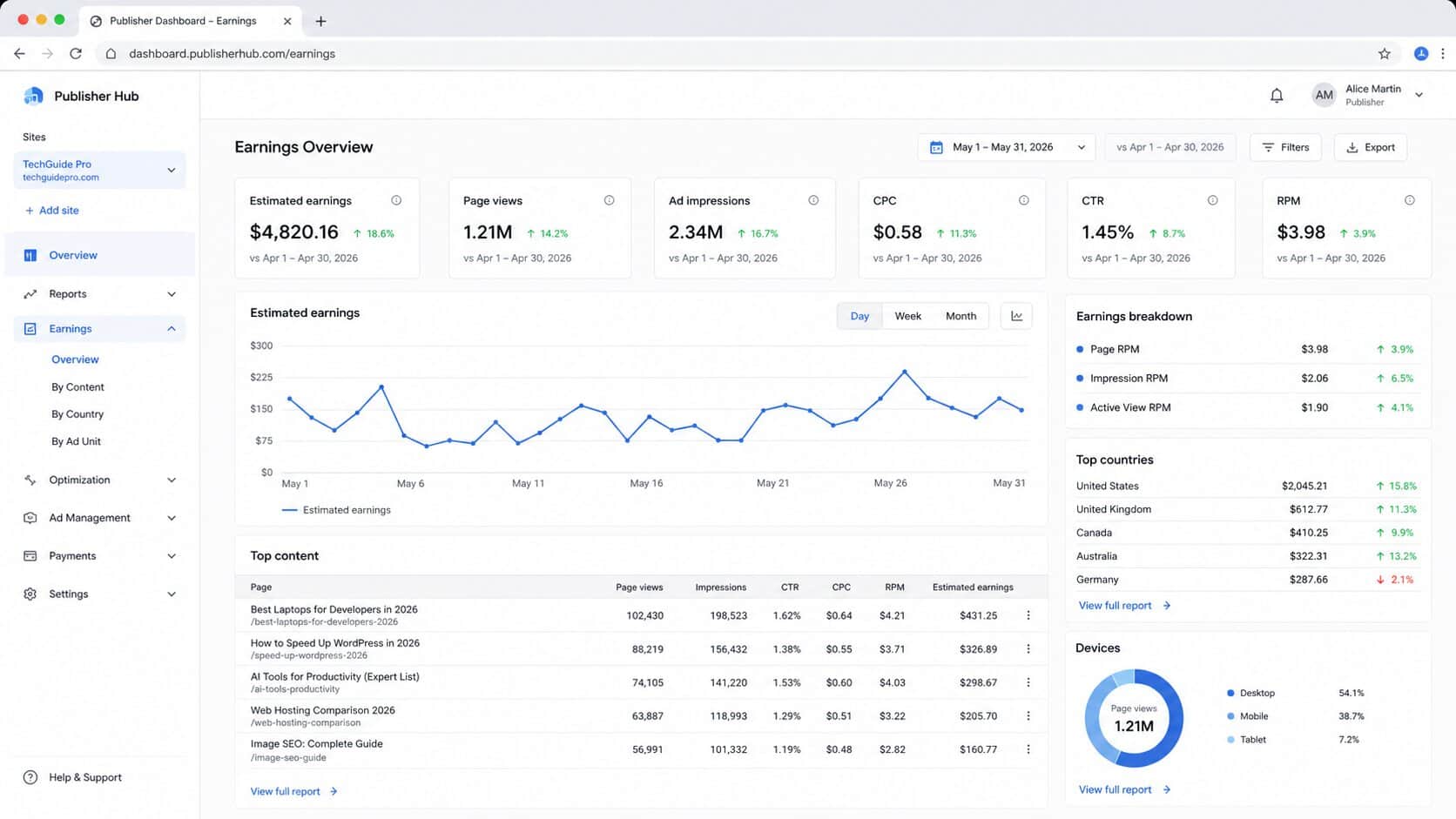
AdSense revenue mostly depends on niche, audience location, content quality, and user behavior on the page. One extra banner rarely fixes the issue if readers leave fast or traffic comes from searches with no commercial value.
The highest rates often appear in topics where advertisers earn a lot from one customer: finance, insurance, SaaS, real estate, and B2B services. Lower rates are more common in memes, broad news, and light entertainment. Traffic may be huge there, but one visitor is worth less to advertisers.
Location matters too. Tier 1 countries usually bring a higher CPC than markets with lower purchasing power. But chasing expensive geo blindly is a trap. If the site does not match search intent or the language feels machine-written, that expensive traffic will not arrive.
How to Get Approved and Set Up Ads
For AdSense approval, a site must look like a real content project, not a shell built for banners. In practice, that means original articles, clear navigation, a contact page, a privacy policy, and no empty sections.
Before applying, check the basics. You do not need 200 pages. It is better to have 15-20 articles that answer specific searches, work well on mobile, and do not copy a competitor's structure line by line.
After approval, there are two ad setup paths. Auto Ads starts monetization quickly and chooses placements by itself. Manual placement gives more control: one unit after the first screen, one in the middle of the article, and no page stuffed with ads. Often the best move is to start with Auto Ads, then remove the most aggressive placements by hand.
Where to Place Ads Without Hurting the Page
Ads should be visible, but they should not block reading. If the first screen is mostly banners, users leave faster and long-term revenue falls. AdSense does not reward the raw number of blocks as much as pages where people stay and interact with the content.
Three placements usually work: after the intro, in the middle of a long article, and near the final section. A sidebar can work on desktop, but it is usually weaker on mobile.
Watch Core Web Vitals as well. Heavy banners, slow hosting, and broken mobile layout drain money quietly. You may still have traffic, but ads load too late or the page loses search visibility.
Mistakes That Can Kill AdSense Revenue
The worst AdSense mistake is trying to speed up earnings with artificial clicks. Google can spot strange patterns: repeated clicks from the same devices, odd sessions, unnatural geography, or a CTR that is too high for the page.
Asking friends to click ads is risky too. So is making banners look like buttons or adding copy such as "support us with a click". That is not optimization. It is a direct path to restrictions.
A less obvious mistake is putting the whole business on one site and one account. If you work with several content projects, traffic arbitrage, or affiliate sites, environment discipline matters. Separate profiles, separate proxies, clean cookies, controlled access. Otherwise one technical slip can affect more than one page.
How to Scale AdSense Projects Carefully
AdSense scaling starts with a repeatable process, not with launching dozens of new sites. You need to know which niche brings RPM, which article patterns attract traffic, which ad placements keep reading comfortable, and how long approval usually takes.
As the number of sites grows, manual control gets messy. Teams mix up access, cookies overlap, proxies get reused, and accounts are opened from the same environment. To Google, this may look like connected activity even when the sites themselves are legitimate.
This is where Afina can fit the workflow. Each site or working account can run in a separate browser profile with its own cookies, cache, fingerprint, and proxy. The team can open the right profiles without constant relogins, while automation handles repeated checks, session launches, and data tasks. It is not a promise of "no risk". It is a way to remove chaos from the process.
DownloadFAQ — Frequently Asked Questions
How much can Google AdSense pay per 1000 views?
The range can go from a few cents to several dollars per 1000 page views. It depends on niche, geography, ad format, CTR, and traffic quality.
How many articles do you need for AdSense approval?
There is no fixed number, but 15-20 useful articles is a practical starting point. Add service pages and clear navigation before applying.
Can you click your own ads?
No. Self-clicks, asking friends to click, and any click incentive violate AdSense rules. These actions can lead to limits or loss of monetization.
Is one long article better than many shorter ones?
A set of focused articles is usually better for a new site. One long piece can rank, but several strong pages give the site more chances to pass review and discover working topics.
Why use an antidetect browser for AdSense projects?
Not every publisher needs one. But when a team manages several sites, accounts, and work environments, isolated profiles help keep cookies, proxies, sessions, and access separate between projects.