LDCloud: is a cloud phone safe for marketing and multi-account management in 2026
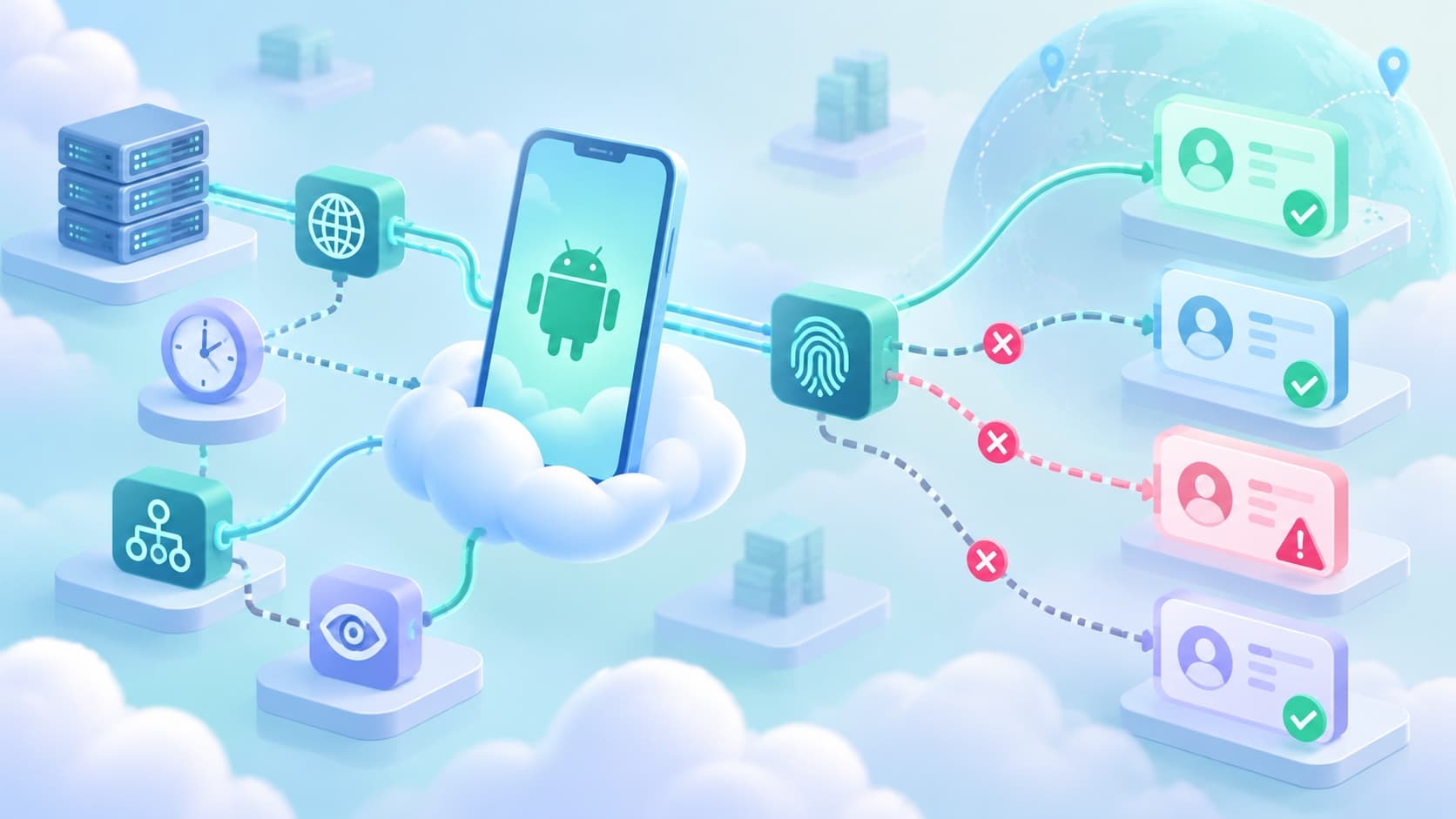
LDCloud means a cloud Android service that launches virtual phones on remote servers for games and constant tasks. It is used to keep apps online 24/7, farm in-game resources, or manage multiple mobile sessions. In real marketing scenarios, price and availability are not the only important factors. Fingerprint, WebRTC, DNS, timezone, IP type, and session stability also matter.
The short conclusion of this LDCloud review: for gaming the service can cover its basic task, but for marketing and multi-accounting it looks risky. According to public tests, problems appear in the exact parameters that antifraud systems used by TikTok, Facebook, and crypto services may consider: a mismatched timezone, real IP leakage, a DNS route through another country, and a datacenter signature. For TikTok Ads and traffic arbitrage, such inconsistencies may increase risk scoring.
A beginner often looks at a cloud phone as a cheap replacement for an antidetect browser: rented Android, connected a proxy, logged into an account, you work. But the platform sees more than the Android screen. It collects network signals, timezone data, WebRTC candidates, the DNS resolver, and cookies. If these layers do not match, a WebRTC leak check quickly shows where the profile falls apart.
What is LDCloud and what tasks is it promoted for
LDCloud is a cloud Android phone for running mobile apps on a remote server, primarily for gaming, AFK farming, and long-running apps without putting a load on the local device. In the positioning of the service the main emphasis is placed on 24/7 online, synchronous control of several devices, gaming accounts and the possibility to launch apps without a constantly switched-on phone or computer.
Public reviews mention VIP, KVIP, XVIP, and MVIP plans ranging from $1.99-$6.99, as well as a 4-hour trial. The price is lower than a full account infrastructure, but a cheap execution environment does not automatically mean high-quality isolation. This is especially important for an ad account, TikTok profile, or crypto account with an established login history.
It is important to separate two tasks. For gaming, a cloud phone needs to keep the app online, stream the screen, and execute commands with acceptable latency. Multi-accounting requires a different set of properties:
- stable fingerprint
- consistent proxy
- separate cookie history
- correct timezone
- clean IP reputation
- no network leaks
That is why a browser profile and Android device are often used for different parts of the workflow instead of being combined into one universal tool.
What criteria are used to evaluate a cloud phone for marketing
A cloud phone for marketing is evaluated not by whether an app launches, but by whether the session looks consistent to an antifraud system. The minimum test set includes server location, proxy, fingerprint checkers, WebRTC, DNS, latency, cookie behavior, and parameter consistency after a restart.
Public LDCloud tests examined server location selection, synchronized control of multiple devices, IP Proxy Manager, a proxy checker, and a performance test. This is a normal methodology for initial screening. It does not prove that an account will be banned, but it shows whether the environment has basic technical contradictions.
A practical testing sequence looks like this:
- choose the server location planned for the account
- connect a proxy from the same country or region
- open a fingerprint checker and verify timezone, WebRTC, language, canvas, and IP
- run a DNS leak test and compare the resolver country
- restart the session and repeat the checks
- log into a test account with no valuable history if all basic signals match
The most frequent mistake here is simple: a person sees that the proxy is connected and considers the task complete. And a proxy is only one layer. If DNS and WebRTC show another country while the timezone remains tied to the server, the environment looks inconsistent across several basic signals.
How stable is LDCloud response speed
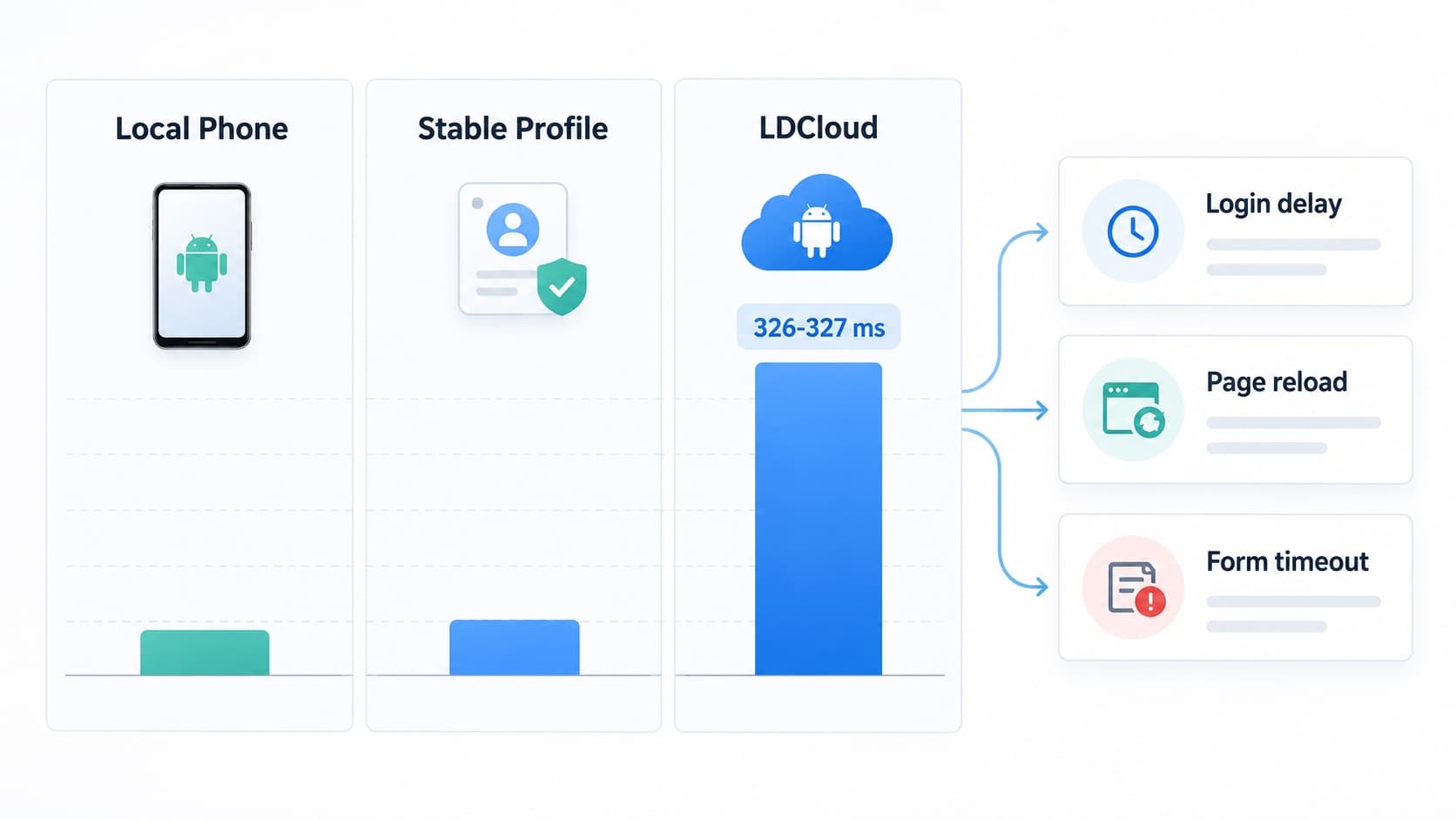
According to public tests, LDCloud showed stable ping at around 326-327 ms, but the actual response was slower than expected for working accounts. For gaming, this latency is unpleasant. For work with an ad account, it may cause operational problems: repeated clicks, long page loads, dropped sessions, or unfinished forms.
A ping of 326-327 ms is not evidence of danger by itself. However, it indicates a remote layer where every action travels along a longer route. If Roblox loading performance drops after connecting a proxy, the network route becomes longer and the app or website receives an unstable connection.
For a media buyer, this appears not as an FPS issue but as operational failures:
- the dashboard freezes
- the verification form does not open
- the payment page asks for another login
Such failures may be accompanied by repeated requests, network route changes, unstable latency, and a datacenter signature that the platform may consider when evaluating the session.
| Scenario | What the user sees | What the platform may see | Practical risk assessment |
|---|---|---|---|
| gaming or AFK farming | noticeable but tolerable latency | app activity from a cloud environment | lower if the account is not valuable |
| TikTok farming | slow actions, long video loading times | unstable mobile pattern and suspicious IP | medium or high |
| Facebook Ads | repeated logins, dashboard lag | unusual network signals during important actions | high for accounts with spend |
| crypto services | delays during login and confirmations | environment that does not match account history | high due to financial risk |
Therefore, speed should be evaluated together with the fingerprint: latency alone does not indicate isolation quality, while a combination of lag and network inconsistencies creates additional technical risk.
What Iphey and Pixelscan fingerprint tests show
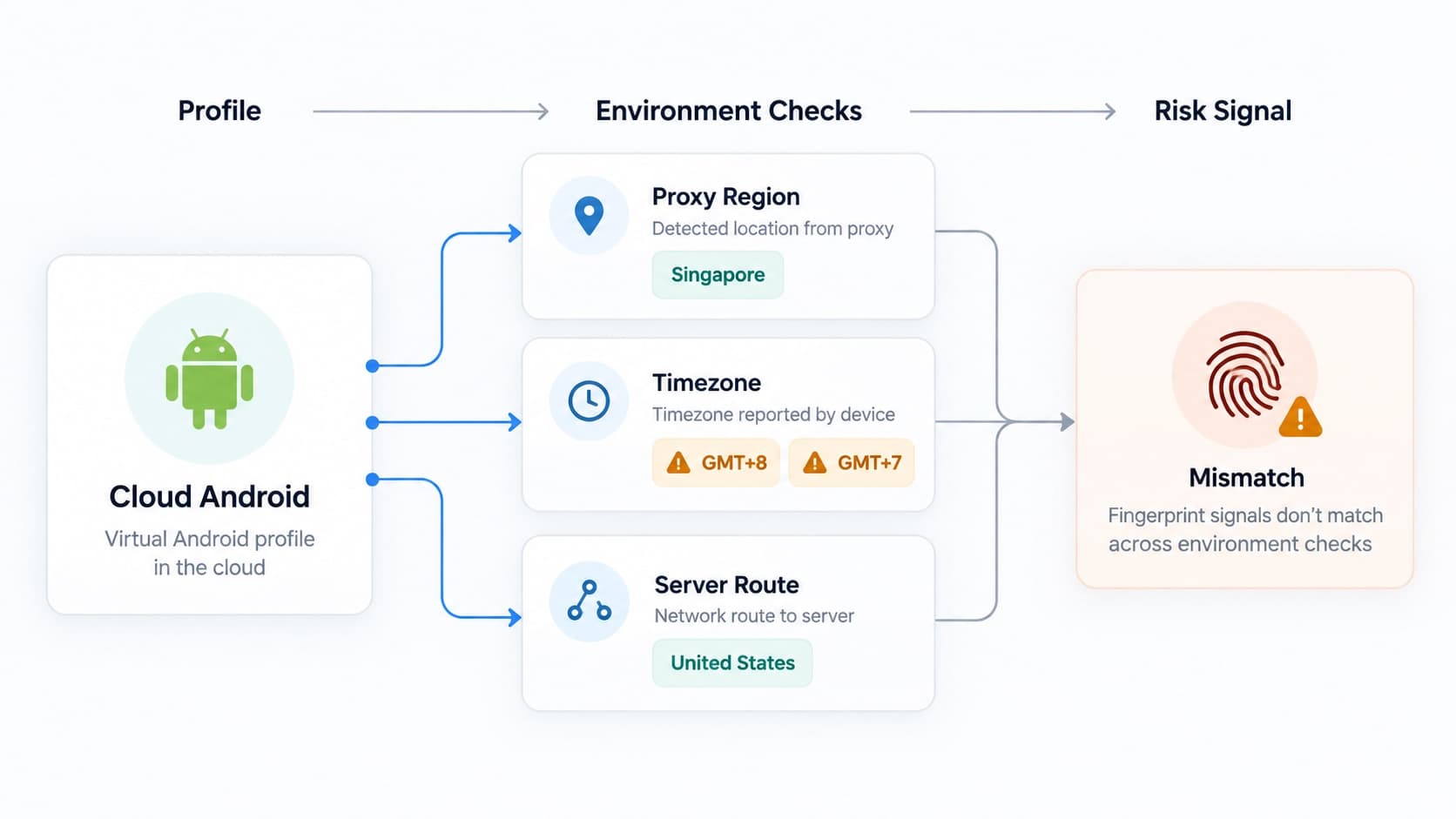
Iphey and Pixelscan tests in public checks showed consistency problems with the LDCloud digital fingerprint. The main signal was that the GMT+8 or GMT+7 timezone did not match the actual location and network route, so the session looked like spoofing rather than a normal mobile device.
A fingerprint checker does not “ban” an account. It shows what a website can see:
- timezone
- system language
- WebGL
- canvas
- user-agent
- network parameters
- IP geolocation
- browser APIs
When geolocation, network parameters, and server signals contradict each other, the session becomes less consistent and may look suspicious to risk assessment systems.
In the case of LDCloud, the timezone appears to be the most noticeable problem. It is almost invisible to an ordinary user, but for an account with an established login history, a mismatch between timezone, IP geolocation, DNS route, and system language creates additional contradictions in the session profile.
To check this without risking a production account, use a short baseline test:
- open a clean session without logging into a valuable account
- connect a proxy for the required region
- check IP geolocation, timezone, WebRTC, and DNS
- compare these parameters with the account history
- postpone the login if even one basic signal contradicts the others
Does the real IP leak through WebRTC and DNS even with a proxy
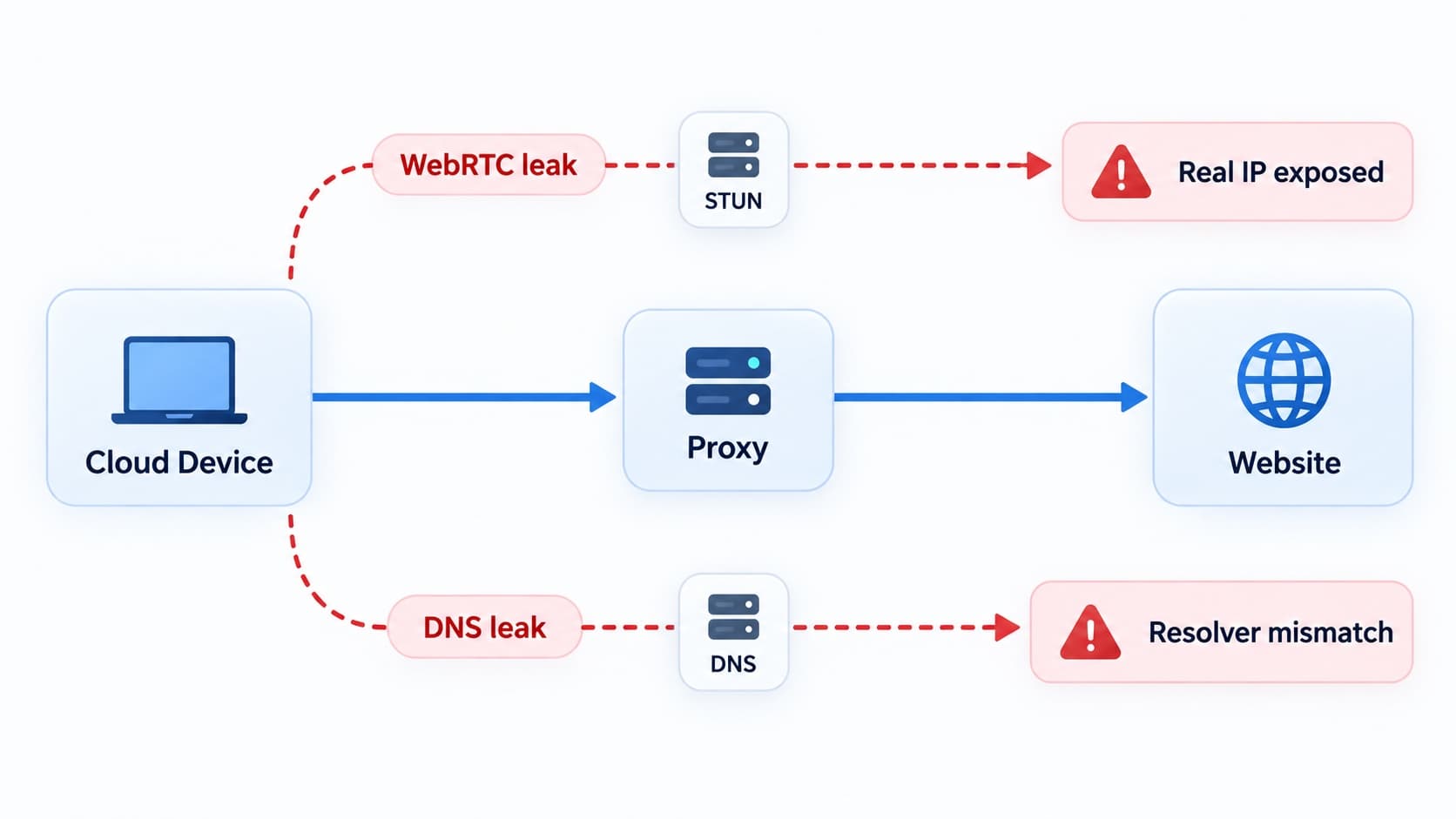
According to the public tests mentioned above, LDCloud showed WebRTC and DNS leaks even after a proxy was connected. The test mentioned a real IP in Shanghai exposed through WebRTC and a DNS route through Singapore, making the proxy incomplete protection for the network layer.
WebRTC can contact STUN servers and reveal IP candidates that do not match the proxy. A DNS leak works differently: the website or test sees which resolver is used to request domains. If the proxy shows one country, WebRTC another, and DNS a third, this no longer resembles normal mobile access.
For TikTok, Facebook, and crypto accounts, this kind of leak matters more than a slow connection itself. The combination creates several contradictory network signals at once.
What you can do before any login:
- check WebRTC with two different checkers
- disable or restrict WebRTC if the tool allows it
- compare the DNS resolver with the proxy country
- do not use proxies with a datacenter signature for warmed-up social accounts
- keep the same route for subsequent logins
In normal multi-accounting, the main goal is not to “hide everything.” The goal is more modest and practical: make the profile look like a stable user device without internal contradictions. This is what distinguishes a managed profile from a random cloud Android environment.
Why this creates a high ban risk for TikTok, Facebook, and crypto accounts
Ban risk increases not because of one bad parameter, but because of a combination of signals:
- mismatched timezone
- WebRTC leak
- DNS leak
- datacenter IP
- unstable session
For TikTok, Facebook, and crypto services, geolocation, login history, IP reputation, device parameters, and session stability may be part of the overall risk assessment. When several of these signals contradict each other, this may increase risk scoring, contribute to linking sessions together, or trigger an additional login check. For financial services, an unusual country, a new environment, a different DNS resolver, or a server IP may also trigger additional verification or temporary restrictions.
The issue with LDCloud in this context is not that it is a “bad service.” It is simply built for a different task. For gaming, it is enough for the app to run in the cloud. Accounts require infrastructure where social media multi-accounting is separated by profiles, proxies, cookies, and repeatable login parameters.
| Criterion | Gaming cloud phone | Antidetect profile |
|---|---|---|
| fingerprint | often depends on the server-side Android environment | configured for an individual profile |
| proxy | can be connected separately but may not prevent every leak | bound to the profile as part of its identity |
| timezone | may not match IP and DNS | aligned with the profile geolocation |
| cookies | stored within the cloud session | isolated between profiles |
| linking risk | higher with shared server signals | lower with proper hygiene |
A managed profile does not cancel account hygiene. A proxy with a poor reputation, mixed cookies, or sudden geolocation changes will still increase scoring, but a controlled stack gives you more control over exactly which parameters the platform sees.
What infrastructure is better suited for working with multiple accounts
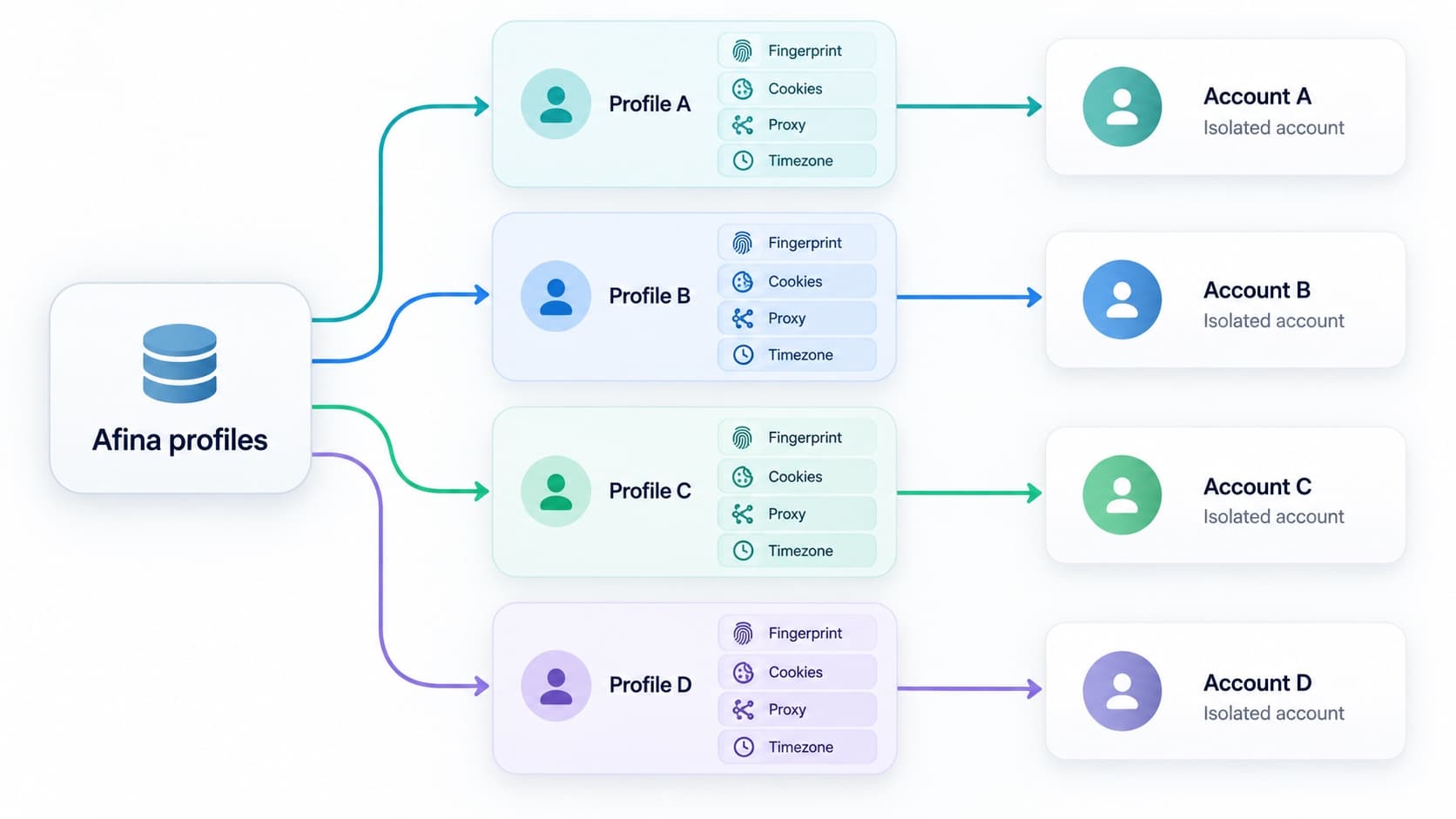
Working accounts need infrastructure where fingerprint, proxy, cookies, timezone, and behavioral patterns do not contradict one another. In practice, this means a separate profile for each account or clearly separated role, a stable proxy, an IP reputation check before login, and the same set of parameters from session to session.
The minimum stack for a media buyer or social media operator looks like this:
- antidetect profile
- residential or mobile proxy for the required geolocation
- separate cookie history
- WebRTC control
- DNS leak test
- login log
Playwright, Selenium, or an API can be added for automation, but only after the manual session passes the basic checks. Automating a poor environment simply scales the mistake faster.
In this scenario, Afina makes it possible to separate work environments into individual profiles: use a separate profile with a proxy, preserve consistent fingerprint parameters and cookie history, and avoid mixing sessions between accounts. This does not override platform requirements and does not guarantee the absence of checks or restrictions. The material is provided exclusively for informational and educational purposes.
Practical conclusion: LDCloud can be tested as a gaming or auxiliary cloud Android environment, but it should not be used as the foundation for TikTok, Facebook, or crypto accounts with valuable history. For marketing, what matters is not simply having an Android screen, but complete consistency of the network and browser environment, including digital fingerprint management at the level of each profile.
DownloadFAQ — Frequently Asked Questions
Can LDCloud be used for TikTok farming?
Yes, technically it can, but LDCloud carries increased risk for production TikTok farming because of possible timezone, WebRTC, DNS, and server-signal mismatches that make the session less consistent. It is better to test the service only with low-value accounts.
Does LDCloud offer a free trial?
Yes, the brief mentions a 4-hour trial. This is enough for an initial check of ping, proxy, fingerprint, and network leaks.
How is a gaming cloud phone different from an antidetect browser?
A gaming cloud phone primarily keeps Android apps online on a remote server. An antidetect browser additionally isolates profiles, cookies, fingerprint, proxy, and timezone for separate accounts, providing more control over environment consistency.
Does a proxy prevent all leaks in LDCloud?
No, a proxy does not automatically prevent all leaks. WebRTC and DNS may reveal the real server route or another country.
What alternative to LDCloud is better suited for social networks?
For social networks, an antidetect profile with a stable proxy and consistent fingerprint is more practical. It gives you more control over which parameters persist between sessions, but it does not by itself guarantee the absence of checks or restrictions.
Can LDCloud be used for crypto accounts?
LDCloud looks risky for crypto accounts because of possible mismatches in IP, DNS, geolocation, and environment parameters. For financial services, such changes may trigger additional verification, especially if they do not match the history of previous logins.